
 Menu
Menu








BEWARE THE IDES OF MARCH
Two weeks into the US/Israel/Iran war, we thought we’d look at what the impact has been so far on various asset classes and at what the options markets are implying about what could happen over the next few months. Obviously, there is a great deal of uncertainty about the endgame. For that reason, the snapshot we provide in this discussion could be out of date within days. Likewise, because of the fluidity of the situation, we will continue to wait before making any tactical changes in strategy.
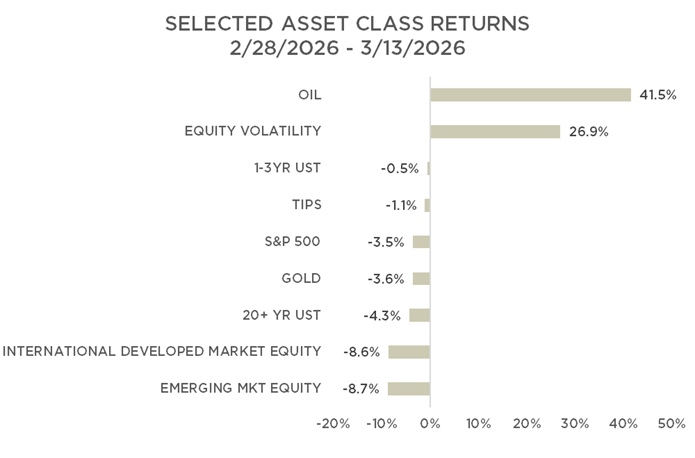
Exhibit 1 shows returns for major asset classes since the war began. By far, the greatest impact has been on the price of oil (Brent Crude), which has risen by more than 41%. US equity volatility has increased by about 27%, which is consistent with the negative 3.5% return of the S&P 500. Developed and emerging market equities are down by 8.6% and 8.7%, respectively. Long US Treasuries declined by 4.3%. Gold, short Treasuries, and Treasury Inflation Protected securities are also lower.
The past two weeks have not been kind to most asset classes.
Exhibit 1. Returns Since the Beginning of the US/Israel/Iran War
Source: Bloomberg, AAFMAA Wealth Management & Trust LLC
To assess the potential performance of these assets classes in the next couple of months through the end of the year, we look to the options market for insight. We’ve selected a representative ETF that tracks each asset class and that has traded options. For options contracts expiring in April, May, and either December or January depending on the asset class, we compute an implied forward return distribution. This is a type of analysis that the Federal Reserve and certain asset allocators use to understand the range of potential return outcomes over a particular investment horizon implied by options pricing. The analysis is “risk neutral,” which means that we can’t use it to forecast expected returns. We can, however, use it to estimate comparative risk levels and the degree to which the implied returns are skewed to the right (extreme higher returns more likely than extreme lower returns) or the left (extreme lower returns more likely than extreme higher returns).
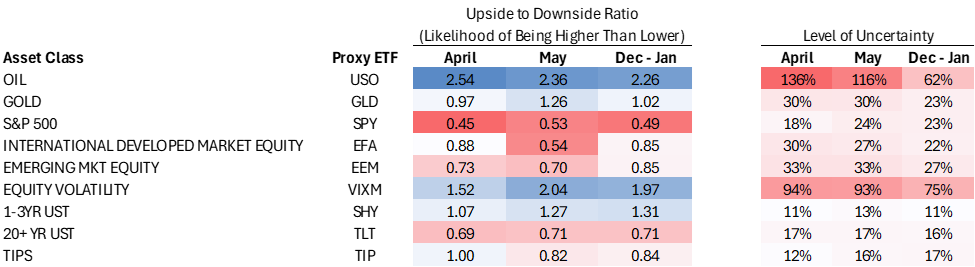
To characterize how skewed to the right or left each asset class is, we take the ratio of the volatility of the best 10% of implied returns to the volatility of the worst 10% of implied returns. That gives us an estimate of “upside” to “downside”. Exhibit 2 shows the ratios for each asset class for each of the three time horizons. It also shows the overall volatility of the implied return distributions, which we label “Level of Uncertainty." The higher the volatility, the less certain the results. Ratios above 1.0 are highlighted in progressive shades of blue, and ratios below 1.0 are highlighted in progressive shades of red. Volatilities are highlighted in progressive shades of red as volatility increases.
Exhibit 2. Upside/Downside Ratios and Level of Uncertainty by Horizon Dates
Source: Bloomberg, AAFMAA Wealth Management & Trust
WHAT DOES IT ALL MEAN?
The analysis suggests that investors believe that large moves higher in oil prices are substantially more likely than large moves lower over each of the one-, two-, and nine-month horizons. Undoubtedly this reflects the negative supply shock caused by the effective closing of the Strait of Hormuz. Given that the upside to downside doesn’t decline measurably by year-end, investors may believe that the Strait represents a longer-term problem.
Both US and international equities appear to have lower upside than downside, with international equities less weighted toward large moves lower. If equities were to decline, that could reflect either or both of a correction after several years of strong performance or an economic slowdown resulting from the war. The fact that the S&P 500 has lower upside to downside compared with international equities may reflect expectations of a reversal in recent US outperformance. The higher upside to downside of equity volatility is consistent with lower upside to downside of equities in general.
From the perspective of the yield curve, investors appear to expect that significant steepening is more likely than significant flattening. The shorter end of the curve (1-3yr UST) exhibits more upside than downside. Higher Treasury returns imply declines in yields. Therefore investors expect that short yields are more likely to decline significantly than rise significantly. Conversely, the lower upside to downside of long Treasuries (20+ yr UST) imply a higher probability of long yields rising significantly than falling significantly.
The upside to downside ratio of TIPS represents expectations about real rates. Flat to lower downside to upside ratios of TIPS over the three horizon periods suggest that investors expect that real rates are more likely to rise significantly than fall significantly. Interestingly, that could be consistent with a pullback in expectations for Fed rate cuts this year. Recent futures market pricing implies less than one full 25bp cut through year-end.
The final observation we make is about gold prices. While through May the market expects higher upside than downside, through year-end, the market believes that upside and downside are evenly balanced. The near-term upside of gold prices may suggest ongoing concern about the war; however that concern seems to be mitigated through year-end.
Distilling everything, we believe the options market is telling us that investors expect the war to continue for at least several weeks, that the closure of the Strait of Hormuz will likely have long-term negative implications, that global equities may suffer, that the yield curve has a good chance of steepening, that the Fed’s likelihood of cutting rates has declined dramatically, and that the risks in gold are more balanced than they’ve been in quite some time.
If it’s all a little bit concerning, it is the Ides of March after all.
Yours in trust,
Secure Your Financial Future with AWM&T
At AAFMAA Wealth Management & Trust LLC, we are committed to serving the unique financial needs of the military community. Whether you require a complimentary portfolio review, a comprehensive financial plan, assistance with your investment strategy, or trust services, our military wealth management professionals are ready to serve you. Contact us today to set up an appointment with a Relationship Manager who can assess your financial health and customize your personalized action plan.
About Us
Founded in 2012, AAFMAA Wealth Management & Trust LLC (AWM&T) was created to meet the distinct financial needs of military families. We proudly deliver experienced, trustworthy financial planning, investment management, and trust administration services – all designed to promote lasting security and independence.
We are proud to share the mission, vision, and values of Armed Forces Mutual, our parent company. We consistently build on the Association’s rich history and tradition to provide our Members with a source of compassion, trust, and protection. At AWM&T, we are committed to serving as your trusted fiduciary, always putting your best interests first. Through Armed Forces Mutual's legacy and our financial guidance, we provide personalized wealth management solutions to military families across generations.
© 2026 AAFMAA Wealth Management & Trust LLC. Information provided by AAFMAA Wealth Management & Trust LLC is not intended to be tax or legal advice. Nothing contained in this communication should be interpreted as such. We encourage you to seek guidance from your tax or legal advisor. Past performance does not guarantee future results. Investments are not FDIC or SIPC insured, are not deposits, nor are they insured by, issued by, or guaranteed by obligations of any government agency or any bank, and they involve risk including possible loss of principal. No information provided herein is intended as personal investment advice or financial recommendation and should not be interpreted as such. The information provided reflects the general views of AAFMAA Wealth Management and Trust LLC but may not reflect client recommendations, investment strategies, or performance. Current and future financial environments may not reflect those illustrated here. Views of AAFMAA Wealth Management & Trust LLC may change based on new information or considerations.
Get In Touch!
Schedule a consultation with one of our expert financial planners today, and let's hit the fast-track to success!
Schedule A ConsultationRelated posts
April 2026 Market Commentary
Read more
May 2026 Market Commentary
Read more