
 Menu
Menu







Don't Miss the Forest for the Trees
The Trees
So far this year, there’s been no shortage of challenging financial, economic, and geopolitical events. There was the war in Iran, skyrocketing oil prices, higher inflation, rising global bond yields, and extraordinarily strong year-to-date global equity market performance. The S&P 500 is up 8.6%, the MSCI EAFE Index 9.4%, and the MSCI Emerging Markets Index an impressive 24.1%.
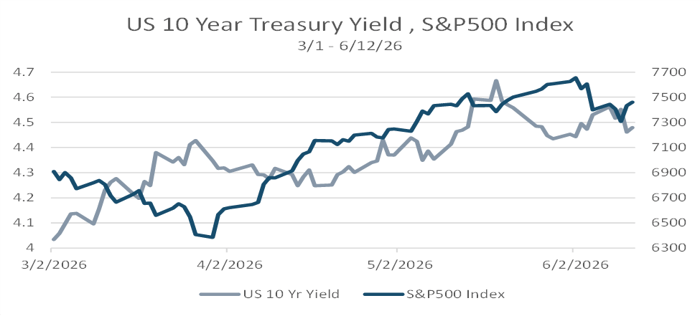
US 10-year yields increased from 3.94% at the end of February to a peak level of 4.66% on May 19th before settling into the current level around 4.48% (see Figure 1). What has been even more eye-opening has been the massive equity rally that occurred between March 30th and June 2nd when the S&P gained 20%. In the backdrop, there’s been the constant nagging doubts about the sustainability of the artificial intelligence/semiconductor rocket fuel that has dominated all other market influences, the culmination of which may have been the SpaceX IPO that catapulted valuations through the stratosphere.
Figure 1
Source: Bloomberg, AAFMAA Wealth Management & Trust LLC
In an environment like this, it’s easy to get distracted by the abruptness of events. Therefore, it’s important to know whether these events have long-term meaning or they are the trees obscuring the forest. In fact, we’ve seen a growing number of analysts forecasting a significant near-term drawdown in the equity market based on one or more of the following related short-term factors:
• Recent extreme upward momentum in the S&P 500 with a focus on the performance of what academics call “the momentum factor”
• Rapidly rising bond yields and a shift towards tighter monetary policy
• Higher trending inflation
In the “trees” part of this commentary, we evaluate the validity of these concerns and conclude that, while rising inflation could be a legitimate source of risk, the momentum in bond yields and equity returns are likely not.
In the “forest” part of the commentary, we discuss why the current level of 10-year US yields suggests that we may be at an inflection point in long-term optimal equity and fixed income portfolio allocations.
The Momentum Factor
The Momentum Factor, in the style of Fama and French, is commonly used in risk modeling and portfolio construction. It can be represented in multiple ways, but a common construction ranks the returns of each security in the S&P 500 over the last 11 months (not including the most recent complete month), then forms a long/short portfolio that owns the top decile (highest returning stocks) and is short the bottom decile (worst performing stocks).
Anecdotal evidence, as well as some custodial data, suggests that there has been a recent surge in buying, especially retail buying, of the equities in the long component of the Momentum Factor portfolio. That generated strong recent performance but reduced overall diversification because portfolios that have high exposure to the Momentum Factor tend to be dominated by a small number of stocks — even if the portfolios hold large numbers of other stocks in different sectors of the market. The concern is that the momentum won’t be able to continue, resulting in a market sell-off.
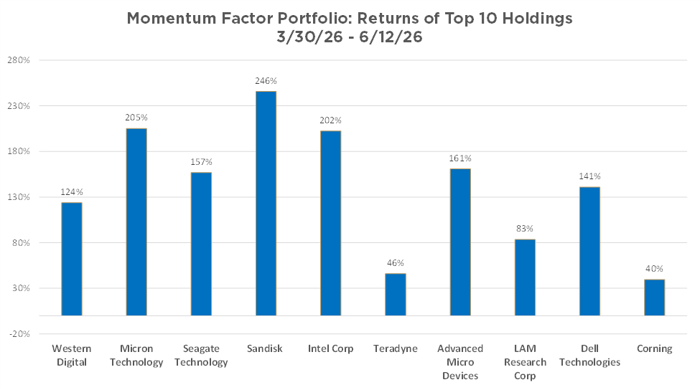
Let’s take a closer look at some of the top holdings in the Momentum Factor portfolio. Figure 2 shows the performance of our estimated top 10 holdings in the Momentum Factor portfolio over the period March 30th to June 12th.
Figure 2
Source: Bloomberg, AAFMAA Wealth Management & Trust LLC
Besides the staggering two and a half month returns, there are other interesting facts worth mentioning. During the time period, the top 10 holdings included seven of the 10 best performing stocks in the S&P 500, yet their combined market capitalization was a mere 4.6% of the index. Notice that there are no megacaps or hyperscalers. Market leadership has continued to be narrow, but there has been a shift away from megacaps. Indeed the valuation premium of the largest five stocks by capitalization has narrowed significantly with the remaining 495 stocks in the S&P 500. Recent strong performance has migrated to new semiconductor, computer hardware and storage companies, signaling an evolution to the next group of beneficiaries of massive artificial intelligence capital expenditures. This trend may have significant implications for portfolio construction as well as alpha generation in the future.
Assembling The Trees
To assess how concerned investors should be about a significant near-term market drawdown, we employ a machine learning technique that explores the relationship between three-month changes in the US 10-year Treasury yield, three-month percentage changes in the Consumer Price Index, three-month S&P 500 returns, and subsequent three-month S&P 500 returns. [1] We use monthly data over the period January 2006 through May 2026.
Our first result refutes the premise that a rapid rise in the 10-year US Treasury yield over a three-month period might be expected to be followed by strong negative returns in the S&P 500. While moves lower in the 10-year yield have been moderately correlated with positive equity market returns, moves higher have not. This makes sense since moves higher could be driven by a number of causes including accelerating economic growth, accelerating inflation, and changes in Treasury supply, only some of which have likely negative implications for equity performance.
On the other hand, our second result supports the premise that large three-month increases in inflation could be followed by negative subsequent three-month S&P 500 returns when the increase in inflation is greater than 1.4%. The current level of the three-month index change is 1.1% so this variable deserves watching. Note that there were only 15 periods when the CPI change was greater than 1.4%. In those periods, the average subsequent move in the S&P 500 was -6.4% — obviously negative but less than a market correction.
Our third result shows that there has not been significant correlation between strong three-month S&P 500 returns and subsequent strong negative three-month returns. In fact, there is little to no evidence in general of near-term mean reversion in equity returns. Conversely, the analysis suggests that three-month returns above 11.2% in a quarter have been loosely associated with positive returns in the following quarter. This conclusion is not surprising as there is a great deal of literature on the lack of information in naïve technical factors such as short-term momentum, 200-day moving average crossovers, and similar measures.
Taken together, the regression tree analysis suggests that none of the proposed factors currently have enough statistical significance to warrant positioning for a short-term market sell-off. Always remember that market timing is a difficult business and over the long term, maintaining your strategic portfolio is more likely to result in success than being in and out of markets.
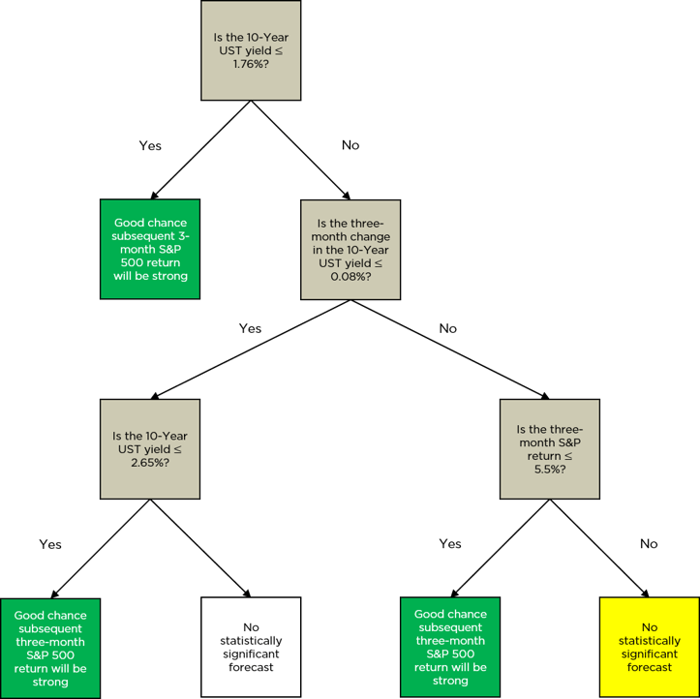
Although, the results of the regression tree analysis did not support the concerns we analyzed, combining the variables with the level of the US 10 Year Treasury Yield at the end of each three-month period does provide an interesting result. Figure 3 shows the decision tree associated with this analysis. The yellow highlighted node corresponds with current circumstances.
Figure 3: Short-Term S&P500 Drawdown Decision Tree Result
Source: Bloomberg, AAFMAA Wealth Management & Trust LLC
The chart shows the level of 10 Year yields to be more important than any of the change variables. Very low levels of 10 year yields, in this case lower than 1.76% (or lower than 2.64% when the three-month change is less than 0.07%) have been associated with relatively strong S&P 500 returns in the following quarter. Maybe we should simply be focused on the fact that we are no longer at low levels of 10-year yields?
And this is where we transition to the forest.
The Forest
Stated simply, after years of ultra-low interest rates, we are in a higher interest rate environment — though still lower than the average 10-year yield over the past 60 years. With all of the volatility in rates, equity markets and inflation, it is easy to be distracted and not realize that the investment environment has changed significantly from the one that began in the mid-2000s. We are approaching 5% in US Treasury yields, a level that we haven’t seen in almost 20 years. At current levels it is much more challenging for US equities to maintain an attractive risk premium (the expected return of equities in excess of the 10-year yield or risk-free rate). In the February Market Commentary, we did an analysis of the cyclically adjusted price earnings ratio. At a level of 36.9 with strong S&P 500 returns over the previous 10 years, the CAPE analysis suggested that annualized S&P 500 returns over the next 10 years would average around 5.2%. Since our last commentary, the CAPE has risen further to 39.8, suggesting an even more extreme level of valuation.
Since we are focusing on US 10-year Treasury yields in the larger context of a higher rate environment, we can alternatively look at the historical relationship between the US 10-year yield and the 10-year subsequent returns of both the S&P 500 and the US investment grade bond market.
Figure 4
Source: Bloomberg, AAFMAA Wealth Management & Trust LLC
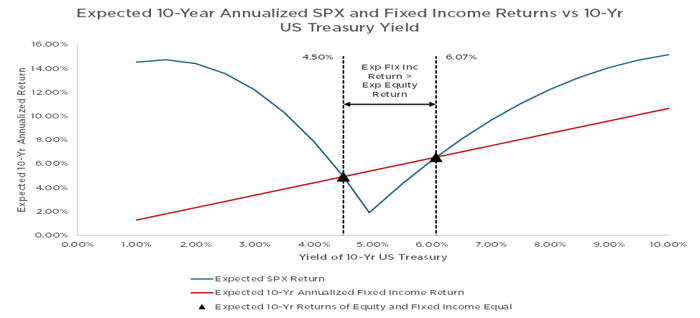
Figure 4 shows the US 10-Year yield on the x-axis and expected equity and fixed income 10-year annualized returns on the y-axis. Based on more than 60 years of historical data, the red line represents the 10-year expected return of the Bloomberg US Aggregate Index (fixed-income), and the blue line represents the 10-year expected return of the S&P 500 (equity). As you can see, when 10-year yields are below 4.00% (the environment that we have recently exited), the expected return of equities is significantly higher than that of fixed-income. At today’s 10-Year yield, roughly 4.5%, the expected 10-year return for equities and fixed-income is about equal. This suggests that, in the current environment, investors can potentially construct a long-term portfolio with similar expected return and much lower risk by increasing the allocation to US bonds compared with US equities.
The primary point, or “forest” in this case, is that we are in a higher interest rate environment with high levels of long-term equity valuation, which suggests that equity returns over the next 10 years will be lower than average. However, we do want to acknowledge some of the other major changes to the forest. After the Great Financial Crisis, there was little appetite for companies to invest heavily in capital expenditures (CAPEX). With the launch of artificial intelligence and the demand for critical infrastructure, CAPEX has been the primary driver of strong earnings growth across markets. This includes not just the US but outside of the US, especially in emerging markets. In a nutshell, the drivers of earnings and the equities that are driving market returns have changed as we saw in our analysis of the Momentum Factor.
Conclusion
If we ignore the considerable amount of noise going on in the market (trees) and avoid over-focusing on short-term market drawdowns that are notoriously hard to predict and statistically unlikely, then each of us are left with the following question: How do the recent changes in the investment environment (forest) affect my strategic portfolio? The answer is that stretched long-term valuations and the higher interest rate environment have narrowed the expected long-term returns between equities and fixed income. As result, it may be possible to create a more efficient portfolio today that meets your long-term return needs with less volatility. Check in with your financial planning professional to explore your current allocations and alternative possibilities.
Yours in trust,
[1] For those curious, the technique is called a Classification and Regression Tree. We use the analysis to determine if there is there any combination of joint changes in the variables that would give us high confidence that a significant drawdown in the S&P 500 might occur over the next three months.
Secure Your Financial Future with AWM&T
At AAFMAA Wealth Management & Trust LLC, we are committed to serving the unique financial needs of the military community. Whether you require a complimentary portfolio review, a comprehensive financial plan, assistance with your investment strategy, or trust services, our military wealth management professionals are ready to serve you. Contact us today to set up an appointment with a Relationship Manager who can assess your financial health and customize your personalized action plan.
About Us
Founded in 2012, AAFMAA Wealth Management & Trust LLC (AWM&T) was created to meet the distinct financial needs of military families. We proudly deliver experienced, trustworthy financial planning, investment management, and trust administration services – all designed to promote lasting security and independence.
We are proud to share the mission, vision, and values of Armed Forces Mutual, our parent company. We consistently build on the Association’s rich history and tradition to provide our Members with a source of compassion, trust, and protection. At AWM&T, we are committed to serving as your trusted fiduciary, always putting your best interests first. Through Armed Forces Mutual's legacy and our financial guidance, we provide personalized wealth management solutions to military families across generations.
© 2026 AAFMAA Wealth Management & Trust LLC. Information provided by AAFMAA Wealth Management & Trust LLC is not intended to be tax or legal advice. Nothing contained in this communication should be interpreted as such. We encourage you to seek guidance from your tax or legal advisor. Past performance does not guarantee future results. Investments are not FDIC or SIPC insured, are not deposits, nor are they insured by, issued by, or guaranteed by obligations of any government agency or any bank, and they involve risk including possible loss of principal. No information provided herein is intended as personal investment advice or financial recommendation and should not be interpreted as such. The information provided reflects the general views of AAFMAA Wealth Management and Trust LLC but may not reflect client recommendations, investment strategies, or performance. Current and future financial environments may not reflect those illustrated here. Views of AAFMAA Wealth Management & Trust LLC may change based on new information or considerations.
Get In Touch!
Schedule a consultation with one of our expert financial planners today, and let's hit the fast-track to success!
Schedule A ConsultationRelated posts
April 2026 Market Commentary
Read more
August 2025 Market Commentary
Read more