Menu
Menu







How the Closing of the Strait of Hormuz Affects US Gas Prices
"You want oil to live above $60, but below $90... If it's $100, every product in America has to readjust its price." — From the Paramount+ show Landman.
If you’re like me and watch a little too much television, you might appreciate the prescience of Billy Bob Thornton’s character, Tommy Norris, in the show Landman. While he wasn’t contemplating a war in the Mideast when he made that comment, the price of oil was above $100 a barrel at the end of April, and his quote does resonate with a question we hear many people asking: if the US does not import much oil that is transported through the Strait of Hormuz, why have domestic gas prices increased so dramatically?
In this report, we look at how and why that can happen.
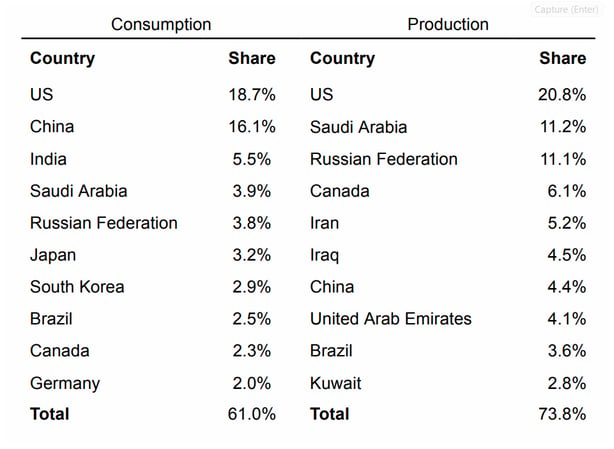
Let’s start with some perspective. According to the U.S. Energy Information Administration (EIA), the US consumes close to 21 million barrels of oil per day. That makes the US the largest consumer in the world (see Exhibit 1). China is second, and the top 10 countries account for 61% of world consumption. The US is also the largest producer of oil in the world, followed by Saudi Arabia, Russia, and Canada.
Exhibit 1. Oil Consumption and Production By Country
*Based on 2024 Data
Source: 2025 Energy Institute Statistical Review of World Energy, AAFMAA Wealth Management & Trust LLC
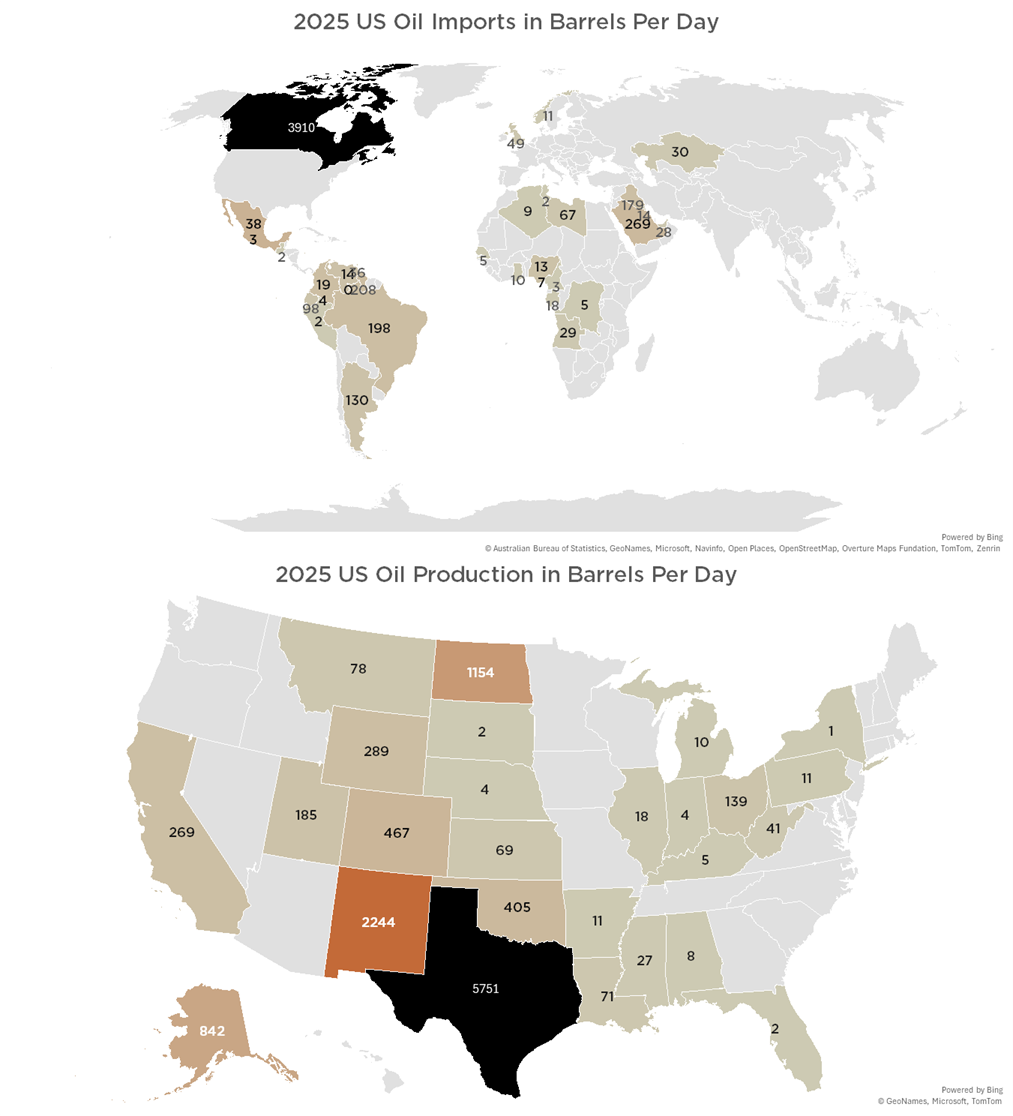
As of the end of February 2026, the US produced about 13.7 million barrels of crude oil per day, imported 6.3 million barrels, and exported 4.0 million barrels. Exhibit 2 shows where US oil imports come from (top map), and where oil is produced within the US (bottom map). As the top map shows, the vast majority of US oil imports come from other countries in the Western Hemisphere, led by Canada with a 63.3% share. Significantly, only about 7.9% of imports come from countries that rely at least partially on transit through the Strait of Hormuz. Of those countries, some, like Saudia Arabia and the United Arab Emirates, also export oil through the Red Sea and may have the ability to redirect flow from oil fields in the east through a pipeline to ports in the west on the Red Sea. As a result, from the US perspective, less than 7.9% of US oil imports are likely at risk from the disruption of Mideast oil supply. In contrast, the direct impact on countries that rely on the Mideast for substantial percentages of their crude oil consumption and exports could be quite different. According to the EIA, these countries include Pakistan (78% of domestic consumption and exports come from the Mideast), Japan (77%), Taiwan (63%), Korea (57%), South Africa (54%), Thailand (50%), India (45%), China (38%), and Vietnam (36%).
Exhibit 2. Where Does US Oil Come From?
Source: U.S. Energy Information Administration, Bloomberg, AAFMAA Wealth Management & Trust LLC
While the direct impact to the US of a Mideast oil supply shock might not seem significant, the indirect impact might be. The share of world oil supply that flows through the Strait of Hormuz is estimated to be about 20%. When that supply is interrupted, demand from the countries that rely heavily on Mideast oil has to shift to other producing countries, including those that do export larger amounts to the US. As a result, US importers face more competition for supply and, consequently, have to pay higher prices to continue importing the same volume of oil. Those higher prices are then passed on to final petroleum products regardless of where the crude oil came from. In addition, in its capacity as an exporter, the US will see increased international demand for domestically produced oil, adding another factor that can contribute to an increase in the prices of petroleum products – like gasoline – sold domestically.
These mechanics can actually be seen in Exhibit 3, which plots US crude oil exports as a percentage of US production. From the end of 2013 through the middle of 2023, the share of US exports rose as the US became a significant crude oil exporter. After a slight decline beginning in 2024, exports then rose explosively in April 2026 (yellow highlighted area of the chart) when the world began to experience the full impact of the closing of the Strait of Hormuz. It’s not clear yet whether US oil imports declined, but we do know that the price paid of those imports was noticeably higher than it was prior to the start of the Iran war. The fact that exports increased so rapidly points to the global nature of the oil market and the interconnectedness of prices.
Exhibit 3. US Crude Oil Exports as a Percentage of US Crude Oil Production

Source: U.S. Energy Information Administration, AAFMAA Wealth Management & Trust LLC
This information begins to illustrate the chain of events that lead from a shutdown of the Strait to higher US gasoline prices despite the fact that the US does not import much oil from the Mideast.
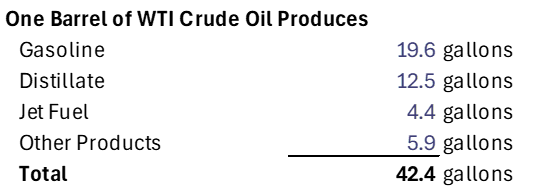
To understand this chain in more detail, we start by looking at the US petroleum products that are produced from a single barrel of crude oil. As Exhibit 4 shows, that barrel ultimately produces close to 20 gallons of regular unleaded gasoline and slightly more than 42 gallons of total product, including 12.5 gallons of distillate and 4.4 gallons of jet fuel.
Exhibit 4. Petroleum Products Produced From One Barrel of Oil
Source: U.S. Energy Information Administration
As an approximation, then, the crude oil input cost of one gallon of gasoline is equivalent to about 2.4% of the cost of a barrel of oil (cost of one barrel of oil divided by 42.4 gallons of total product). We can see this in Exhibit 5, which estimates the component costs of a gallon of unleaded regular gasoline at the beginning of the Iran war based on industry averages. Oil constitutes about half the cost. Refining, distribution and marketing, and taxes constitute the remainder. Because there are both federal and state taxes, the tax component varies widely by state.
Exhibit 5. Estimated Component Costs of a Gallon of Gasoline on 2/27/2026

*Based on West Texas Intermediate price of $67.02/barrel
Source: U.S. Energy Information Administration, Bloomberg, AAFMAA Wealth Management & Trust LLC
The actual average cost of a gallon of regular unleaded gasoline at the beginning of the Iran war was $2.98 – close to the estimated $3.10 in Exhibit 5. At the month-end March and month-end April, the costs were $4.06 and $4.39, respectively. Exhibit 6 lays out the chronology of gasoline and oil price changes over the period. From the beginning of the war through the end of April, unleaded regular gasoline prices rose by about 47%. Over the same period West Texas Intermediate (WTI) and Brent Crude prices each rose by approximately 57%. WTI is a type of crude oil and its futures price is frequently used as the benchmark for US oil prices. Similarly, Brent Crude is the futures price benchmark for most oil produced outside of the US, including oil that transits through the Strait of Hormuz. Most, but not all, of the crude oil price increases were passed through to the price of gasoline – likely because the costs of refining and distribution and marketing remain fixed despite the cost of crude oil going up.
Exhibit 6. Gasoline and Crude Oil Price Increases in March and April 2026

Source: U.S. Energy Information Administration, American Automobile Association, Bloomberg, AAFMAA Wealth Management & Trust LLC
Putting everything together, we can construct a simple model to explain how unleaded regular gasoline prices change when supply through the Strait is interrupted. Step 1 translates the percentage change in the price of Brent Crude (due to the negative supply shock) to a percentage change in WTI. Recall that Brent Crude reflects the cost of Mideast oil, and WTI reflects the cost of US-produced oil (whose supply initially is unaffected by the closure of the Strait).[1] Since the advent of the fracking era (circa 2011), percentage changes in Brent Crude and WTI have been highly correlated. For every percentage point increase in Brent Crude over the course of a month, WTI would be expected to increase by slightly more than 1.03 percentage points.
In Step 2, we use the estimated percentage change in WTI as the input cost to a gallon of gasoline within the framework that we referenced in Exhibit 5. We assume that the refining and distribution and marketing costs stay constant and that taxes increase proportionately with the change in the price of WTI.
Exhibit 7 walks through our forecast of the percentage change in gasoline that would have been expected based on actual changes in the cost of Brent Crude. We would have expected a 59.2% change in WTI over the period, an ending WTI price of $106.69, and an ending gasoline price of $4.37. The actual ending price of WTI was $105.07, and the ending price of gasoline was $4.39. These estimates are close enough to actual to suggest that it really does make sense that US gasoline prices can go up dramatically even though the US imports a minor amount of oil that flows through the Strait.
Exhibit 7. Forecasting How Much Gasoline Prices Would Have Been Expected to Change From the Beginning of the Iran war through the End of May 2026

Source: U.S. Energy Information Administration, American Automobile Association, Bloomberg, AAFMAA Wealth Management & Trust LLC
One additional interesting note: The US consumes approximately 375 million gallons of gasoline per day. Considering the daily price of gasoline on every day of March and April 2026 compared with the price of gasoline on February 28th when the Iran war began, US consumers have already paid about $21 billion more for gasoline than they would presumably have paid had the war not started.
The markets have not seemed to care. Over the course of the conflict, risk asset prices initially declined, then rallied, despite the sustained increase in oil prices. The S&P 500 increased by an astronomical 10.5% in April after declining 5.0% in March. There have only been eight other months in the past 50 years when the S&P 500 has rallied more than that. The MSCI Emerging Markets Index rallied 14.7% in April after declining 13.0% in March. Similarly, that was the seventh largest rally in the past 40 years. We’re struggling to understand this level of optimism, especially when, as we pointed out earlier, many emerging market countries depend heavily on Mideast oil. The narrative on Wall Street is that the positive impact of growth in artificial intelligence earnings is more important (and more permanent) than the negative impact of the oil supply shock.
We have remained steady in our holdings and will continue to watch both the positive and negative factors closely. Let’s hope for Mideast peace.
Yours in trust,
[1] At the cost of additional complexity, we could start one step earlier by estimating the likely percentage price change in Brent Crude based on the extent of the negative supply shock. To do that we would need to forecast how large the supply shock was going to be – in other words, how much of the 20% of the world’s oil supply that flows through the Strait would actually be cut off and for how long. Using the price elasticity of oil demand, we would then estimate the likely change in price. For simplicity we leave that out of the discussion above; however, our modeling suggests that at the end of April, market participants were anticipating a roughly 9% decline in oil supply lasting for about one quarter.
Secure Your Financial Future with AWM&T
At AAFMAA Wealth Management & Trust LLC, we are committed to serving the unique financial needs of the military community. Whether you require a complimentary portfolio review, a comprehensive financial plan, assistance with your investment strategy, or trust services, our military wealth management professionals are ready to serve you. Contact us today to set up an appointment with a Relationship Manager who can assess your financial health and customize your personalized action plan.
About Us
Founded in 2012, AAFMAA Wealth Management & Trust LLC (AWM&T) was created to meet the distinct financial needs of military families. We proudly deliver experienced, trustworthy financial planning, investment management, and trust administration services – all designed to promote lasting security and independence.
We are proud to share the mission, vision, and values of Armed Forces Mutual, our parent company. We consistently build on the Association’s rich history and tradition to provide our Members with a source of compassion, trust, and protection. At AWM&T, we are committed to serving as your trusted fiduciary, always putting your best interests first. Through Armed Forces Mutual's legacy and our financial guidance, we provide personalized wealth management solutions to military families across generations.
© 2026 AAFMAA Wealth Management & Trust LLC. Information provided by AAFMAA Wealth Management & Trust LLC is not intended to be tax or legal advice. Nothing contained in this communication should be interpreted as such. We encourage you to seek guidance from your tax or legal advisor. Past performance does not guarantee future results. Investments are not FDIC or SIPC insured, are not deposits, nor are they insured by, issued by, or guaranteed by obligations of any government agency or any bank, and they involve risk including possible loss of principal. No information provided herein is intended as personal investment advice or financial recommendation and should not be interpreted as such. The information provided reflects the general views of AAFMAA Wealth Management and Trust LLC but may not reflect client recommendations, investment strategies, or performance. Current and future financial environments may not reflect those illustrated here. Views of AAFMAA Wealth Management & Trust LLC may change based on new information or considerations.
Get In Touch!
Schedule a consultation with one of our expert financial planners today, and let's hit the fast-track to success!
Schedule A ConsultationRelated posts
May 2025 Market Commentary
Read more
2025 Q4 Market Recap
Read more